Where strength and precision come together to stack insulation panels
IMA built an energy-efficient stacking line for Recticel using Siemens SINAMICS S220 drives. Higher speed, lower costs, maximum reliability.
How can we make the production and logistics of insulation materials as sustainable as possible? IMA built a stacker for Recticel that maximizes electrical energy recovery and minimizes downtime and product loss.
Fast and Robust Sheet Metal Processing
A lot can go wrong when stacking and packaging insulation panels by machine. The panels can warp, pieces can break off, pallets can tip over… In all these cases, the panels become unusable. This is a shame for the environment and for the panel manufacturer. That’s why Recticel approached IMA with very strict requirements: the stackers they ordered had to be extremely robust, fast, and as energy-efficient as possible.
“There’s a lot going on at the packaging line—and it’s fast-paced, too,” says Nicolas Vandycke, project manager at IMA. “Every so often, a 6-meter roll of sheet material rolls in, either 60 cm or 120 cm wide. We feed that material into a vacuum frame and stack it up to 75 cm high. We clamp that stack in place and pull it apart into pieces ranging from 60 cm to 3 meters. We pick up those pieces with a very large gantry picker and place them staggered on a pallet. Afterward, the pallets are wrapped in plastic film and placed on a roller conveyor, where a forklift picks them up.”
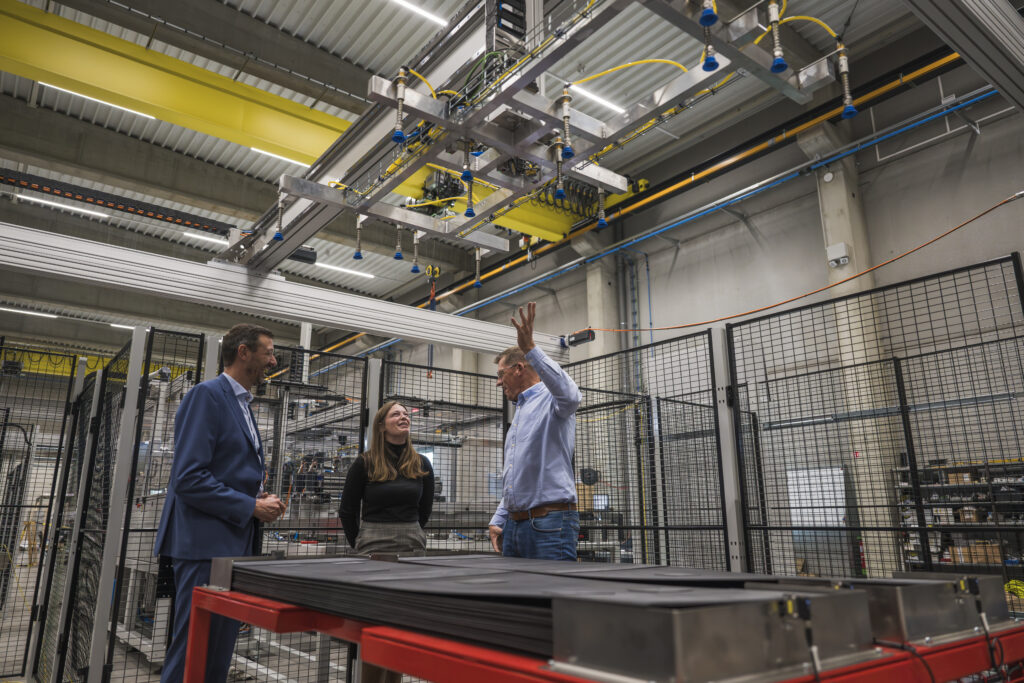
Challenge 1: Avoiding Vibrations
“Insulation panels are large. That’s exactly why you need a heavy, sturdy machine: no part should flex, or the panels could be damaged. That’s why we built the machine to be extremely robust. And we’re confident that no damage will occur—we didn’t allow for any room for failure.”
But the robustness isn’t just in the mechanics. “We’re using the new SINAMICS S220 drive systems here. They can be tuned with great precision. With Siemens’ help, we were able to eliminate all frequencies from the motor’s motion profile that would cause vibrations in the mechanical components. As a result, everything runs completely vibration-free.”
“In the S220, we included more intermediate power ratings,” adds Jeroen Pieters, account manager at Siemens. “This allowed us to recommend a drive system that more closely matched the required power, helping IMA and Recticel save costs. The motor modules are smaller, so they also take up less space in the cabinet.”

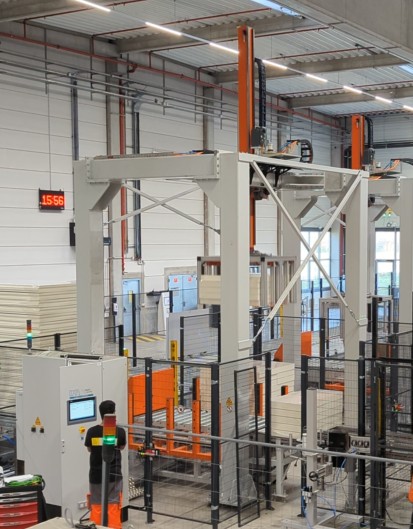


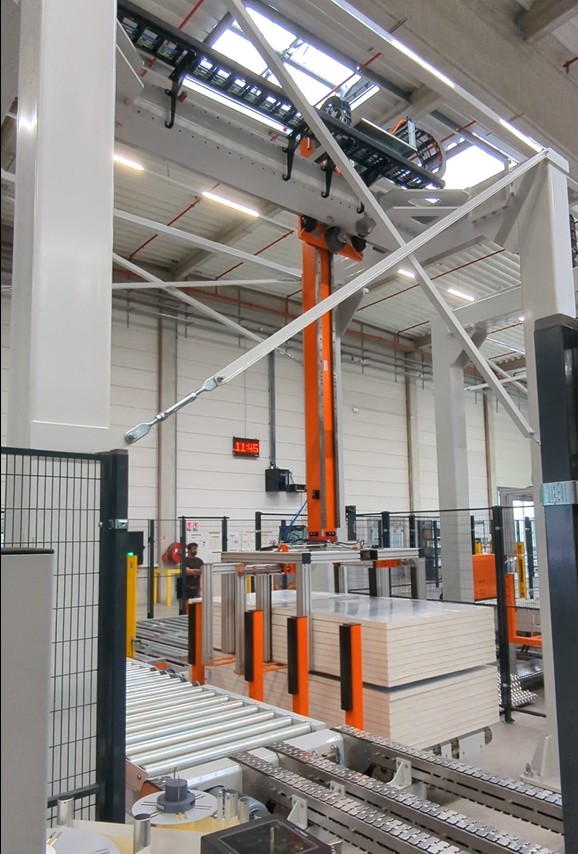

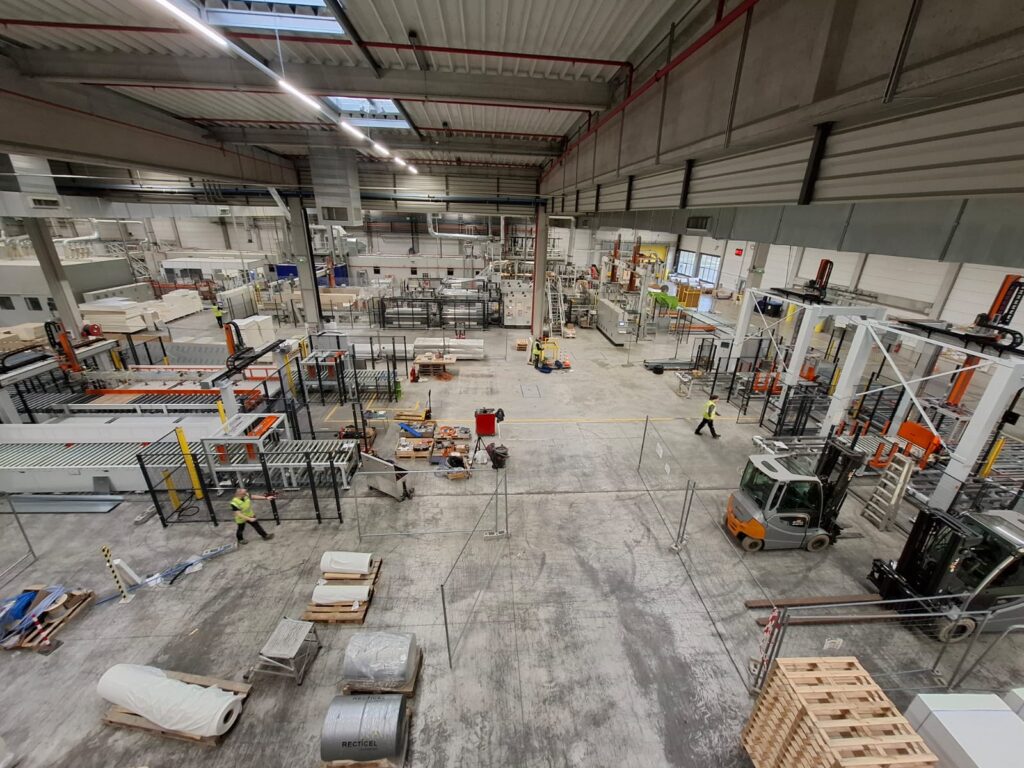
The SINAMICS S220 motor modules are smaller than those of its predecessor, allowing IMA to save on cabinet space.
Jeroen Pieters, Account Manager, Siemens
Challenge 2: Speed
The required cycle times were very challenging. IMA achieves them by running the line in parallel, both at the front and at the back. Nicolas: “Picking up insulation panels at that speed is no easy task, because you have to be able to grip each panel perfectly, and there are many different combinations of lengths. That’s why we set up two feed lines, with their motors synchronized. Using technological components, we built a virtual link between the two lines, as if there were a crankshaft connecting them.”
“We don’t want one line to move more than the other, because then we wouldn’t be able to separate the panels. As long as everything goes smoothly, synchronization is easy. But we also wanted to account for all potential issues: emergency stops, a motor failure while another is accelerating… That wasn’t easy. During commissioning, Siemens was right there with us to provide support.”

Synchronizing supply lines is easy when everything goes smoothly. But to cover all other scenarios as well, Siemens has stepped in to provide support.
Nicolas Vandycke, Project Manager, IMA
Challenge 3: Energy Recovery
About ten motors start and stop several times during the cycle to maintain the high speed of the process. “Lifting, lowering, pulling apart, lifting again, lowering … Without energy recovery, decelerating all those movements would generate a lot of heat and result in significant energy loss. Thanks to a shared DC link, the braking energy from one motor is used to start another. That quickly saves 10% in energy.”
Result: an efficient process with no product loss
“We always fully assemble our machines at IMA. Here, we test them thoroughly, and only after full validation do they assemble them on-site. This is a major advantage for the customer, because it means we don’t have to occupy their production facility for months on end. Recticel was impressed when they came to take a look. Our cycle times are even better than expected.”
“The machine operates fully automatically, without any operator intervention. Everything is selected automatically. We check the thickness and length of the panels and the height of the stacks at various points. If something does go wrong, we can monitor the process remotely to assist Recticel.”
“There’s no product loss: thanks to the machine’s robust construction, the secure gantry picker, and precise synchronization, no panels warp. Thanks to Siemens’ technology and support, we were able to complete this job. The collaboration with Siemens went smoothly, and the support was excellent. We will definitely use the S220 more often.”
The Benefits in a Nutshell
- cycle times faster than planned
- Energy efficiency: braking energy recovered via S220 drives
- More compact cabinets and lower costs thanks to smaller drive modules
- reliable, stable operation without product loss
- user-friendly and low-maintenance system
- remote monitoring for remote support